
Time to Taper: The Science Behind Why Less Running Makes You Faster
A deep dive into the science of the taper, why 'taper tantrums' happen, and how to reveal your peak performance.


This one's for the runners out there, because as of the time of writing this, we are less than 2 weeks from the London Marathon.
If you've been following a training programme, possibly given to you by an online running coach, let's call him "Al", you should be in the middle of your "taper" period right now. That's the 2-3 week period when Al has told you that you now need to cut back on your training volume so you can get a better performance on race day.
But you may be thinking, "I haven't done enough. If I run less now, I'll lose my edge. I need more miles if I want to do a sub-4 hours". You're not alone in thinking like this. So, in this blog, we're going to help you understand why you need to taper before a long-distance race and why the odd thoughts and feelings you may experience during this period are par of the course.
The Fitness-Fatigue Model
The chart below shows the physiological happenings when you go through a standard 16-week marathon training program. Note that the values are not absolutes but are illustrative to give you an idea of how each parameter changes over time.
Interactive fitness-fatigue model across a 16-week marathon training plan, showing how tapering in the final 3 weeks removes fatigue while preserving fitness to produce peak race-day performance.
Hover over any week to explore what is happening physiologically
The highlighted points at weeks 13, 15, and race day reveal the three key moments that explain why tapering works.
Training load profile modelled on standard 16-week recreational marathon plans (Higdon, 2020; Hansons Marathon Method, 2012). Fitness and fatigue curves derived from the Banister impulse-response model (Banister et al., 1975; Morton et al., 1990). Taper duration and performance benefit: Smyth & Lawlor, Frontiers in Sports and Active Living, 2021.
Why should we taper before a marathon?
Tapering for a marathon is a bit like prepping for a bodybuilding competition. You've done the "bulking" (the 18-mile-long runs). Now you're shedding the metaphorical fat, which for runners is the fatigue that's accumulated over several weeks of training.
You might see this fatigue in your recovery metrics:
- Your heart rate variability (HRV) decreases, suggesting a stressed autonomic nervous system.
- Resting heart rate creeps up.
- Creatine Kinase, a marker of muscle micro-damage, may start to rise.
By doing a tapering period, the aim is to reduce this fatigue so you can reveal your true running potential.
But won't I lose my fitness if I taper?
This is a common worry for new runners, but rest assured, you don't lose fitness during the taper period.
The main driver of detraining is usually a prolonged reduction in the training stimulus. This means a long period of reduced training intensity and frequency.
When you taper your training, you don't stop exercising. You do enough to maintain the adaptations that you've already achieved, whilst letting your recovery catch up.
By reducing your training volume, your fatigue drops sharply while your fitness remains perfectly stable. In sports science, this is known as the fitness-fatigue model - see earlier for an illustration.
So how long can you taper for, you may wonder? In some studies looking at endurance athletes this can be as long as 4 weeks. Of course, if the taper is too long or too easy, your fitness will start to drift downwards.
Not just for Marathons
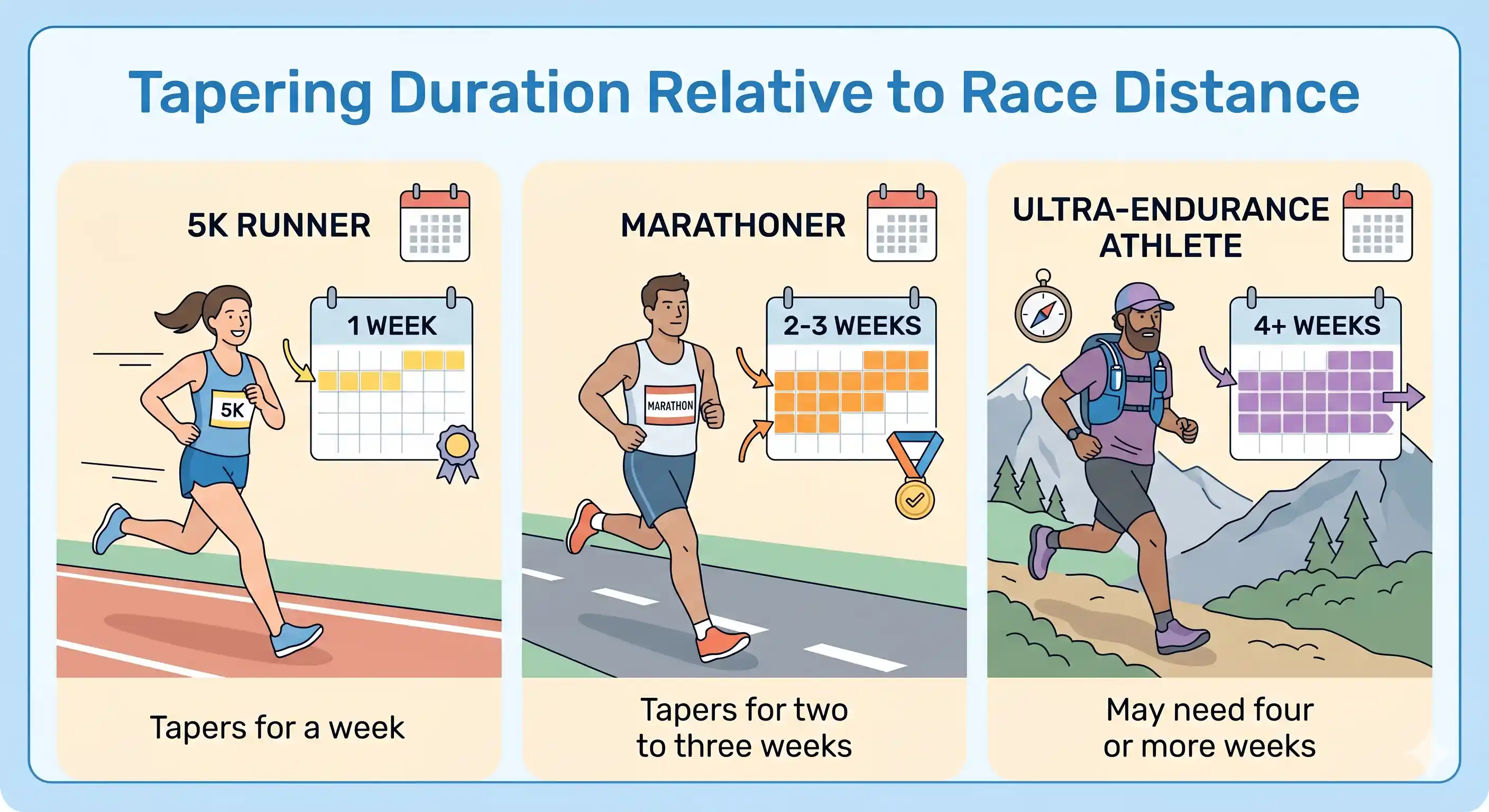
Tapering is not unique to the marathon. Elite athletes taper before every major event, from a 5K to an Ironman, but the principle scales with the distance. The longer the training block, the longer the taper needed to clear the accumulated fatigue.
What stays constant across is the underlying biology: fatigue clears faster than fitness decays, and peak performance requires giving it the space to do so.
If tapering is good for me, why do I feel bad?
Marathon tapering is famously associated with a period of not feeling great. Anxiety creeps in, new pains appear from nowhere, and your easy runs feel oddly heavy. Collectively, runners call this taper madness. But each symptom has a physiological explanation.
The Neurochemical "Sugar Crash"
Over 13 weeks of high-mileage training, your brain has been receiving a steady supply of endorphins, serotonin, dopamine, and endocannabinoids. These are mood-enhancing and anxiety-reducing, and a big reason why people become addicted to running.
When you cut the mileage sharply you cut the supply of these endogenous chemicals, but their receptors remain upregulated. The result is a withdrawal-like experience: irritability, flatness, and anxiety.
Endurance athletes can experience up to 40% rise in anxiety levels when their training volume is reduced by more than 30% during a taper.
It's also the reason why people who regularly run can become more difficult when they're not able to for one reason or another. These negative feelings are just your brain throwing a tantrum. A taper tantrum.
Heavy Legs
During peak training, your muscles are chronically depleted of glycogen (carbohydrates store). When you reduce how much running you're doing but maintain your carb intake, your body super-compensates to storing 20 to 40% more glycogen than normal.
Good for race day. Not so good for the easy Tuesday jog.
For every gram of glycogen, three grams of water are pulled into the muscle making your legs feel like lead. That's a full fuel tank, not a problem.
Phantom Pains
You've spent months ignoring minor aches because, frankly, you were too tired to notice them. When training load drops, your immune system comes back online and starts addressing lingering inflammation and tissue repair. In addition, without 50 miles a week to occupy your attention, your brain begins cataloguing every bodily sensation it previously ignored.
The result: pains that seem to appear out of nowhere and migrate around the body. Most of these are phantom.
Your Taper Survival Guide
The Taper Timeline
- Reframe the Rest: Stop telling yourself, "I'm losing fitness". Start telling yourself, "I am shedding fatigue to reveal my fitness." The distinction isn't just motivational, it's physiologically accurate.
- Visualise Success: Runners who understand why taper symptoms happen report significantly less anxiety. Use the time you'd have spent running to mentally rehearse your race: the fuelling plan, mile 20, the finish.
- Sleep is the workout now. Avoid the marathon expo trap of four hours on your feet the day before. Aim for 8 or more hours - human growth hormone, the primary driver of tissue repair, is released during deep sleep.
- Check the log, not the doubt. When panic sets in, open your training diary. The weeks of work are already banked. More miles now cannot add to that, but they can take from it.
Taper anxiety is a crisis of confidence, not a crisis of fitness. The chart above is your proof. Your body is not declining during these final weeks. It is preparing.
Trust what the data already shows you.
Good luck.