The ACSM Now Recommends Power Training for All Adults. Is the Fitness Industry Ready?
The ACSM has just recommended power training for healthy adults for the first time. A sports medicine physician explains why this is the most clinically significant update in the guidelines, the real injury risk it carries, and whether the fitness industry is ready to deliver it safely.

Last year, Shelly-Ann Fraser-Pryce, eight-time Olympic gold medallist, lined up at her son's sports day for the parents' 100m race. One of the greatest sprinters in history, against the rest. Needless to say, she won by a distance, barely breaking into a sweat. It is genuinely a joy to watch.
Now, think about the last time you sprinted. I mean genuinely, full-out, maximum effort. Perhaps you were racing for a train, or sprinting after a child careening towards a busy road.
For most of us, the honest answer is: not recently. And for most people, that sudden burst of speed may carry a high price, such as a pulled hamstring or a strained calf. The reason is simple: your muscle-tendon units are no longer conditioned for explosive movement, irrespective of how many 10k runs or gym sessions you do.
In March 2026, the American College of Sports Medicine (ACSM) published its first major update to resistance training guidelines in 17 years. I have written about the broader changes here. But buried inside is a recommendation that, in my opinion, carries the greatest clinical significance and, if delivered poorly, could lead to a surge in soft tissue injuries.
That recommendation is Power Training.
Power Training Is Not the Same as Powerlifting
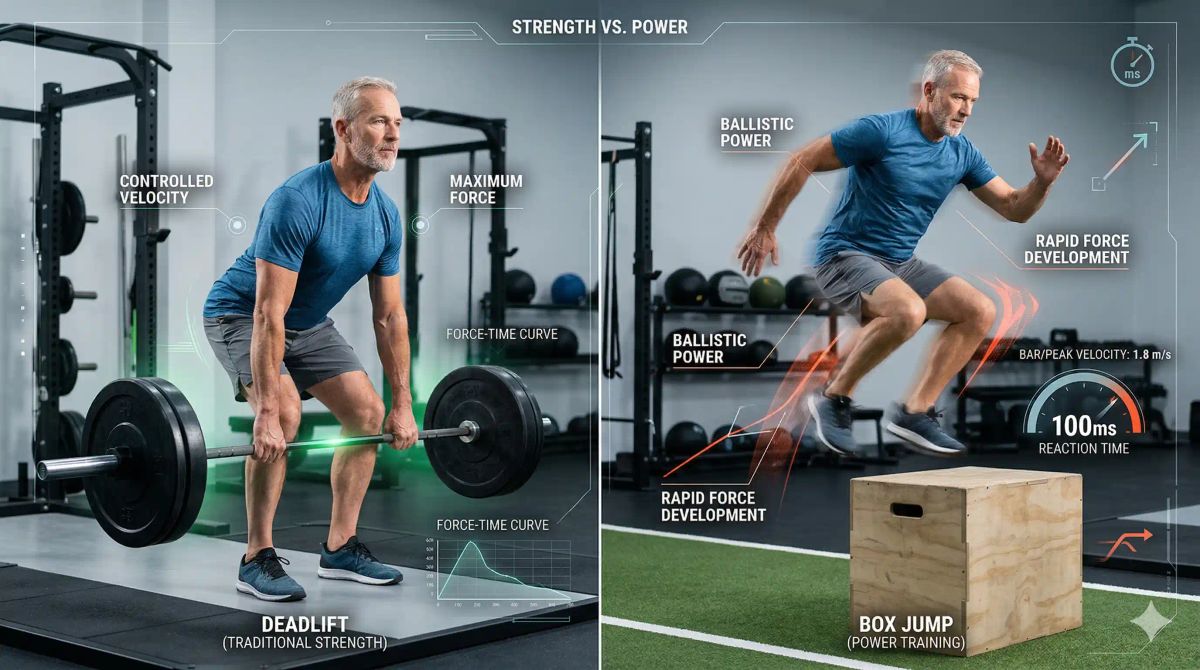
Before we continue, we must clear up a confusion that regularly muddies the public conversation. While used interchangeably in marketing, power training and power lifting describe fundamentally different physiological tasks:
The purest expression of power training is Olympic weightlifting: the snatch and the clean and jerk. These movements are ballistic and explosive by nature.
Why does the distinction matter? Because the injury profile and the coaching requirements for these two worlds are entirely different.
Why Power, and Why Now?
I have a saying: "Exercise as if your life depends on it." What I mean is that our exercise regimen should suit whatever stage we are at in life, whether that is developing fine motor skills in infancy or laying down bone mass during adolescence to protect against osteoporosis in later life.
In the UK, falls are the most common cause of injury-related death in people over 65, costing the NHS over £2 billion a year. But falling is not primarily a strength problem; it is a power problem.
Falling is not a strength problem. It is a power problem. The window between a trip and a fall is measured in milliseconds, and no amount of slow, heavy squatting trains the body to close it.
When you trip on a kerb, your ability to deadlift 150kg is mostly irrelevant. What matters is how quickly you can move your leg 30cm in 100 milliseconds. This neuromuscular speed, the body's capacity to detect instability and generate a corrective force fast enough, declines earlier and more steeply than muscle strength as we age.
We now call this phenomenon 'powerpenia', which is distinct from 'sarcopenia', the loss of muscle mass over time. Research estimates that after the age of 60, muscle mass declines by 1% per year and strength by 2%, while muscle power diminishes at a staggering 3% per year.
The ACSM’s new recommendation is an attempt to "fall-proof" our ageing population. My concern, however, is that power training carries the highest risk of injury, and that risk is greatest in the group that needs it most: those who have gone the longest without explosive conditioning.
The CrossFit Cautionary Tale
The commercial fitness industry moves fast. Soon, elliptical machines will be swapped for smart racks with bar-velocity sensors. "Power-HIIT" will become the new Zumba, and "Signature Classes" with names like "The Velocity Protocol" will begin to pop up at your local gym.
We don't have to speculate about what happens when explosive, technically demanding movements are introduced into high-volume group settings without adequate supervision. We have a real-world example in the sport of CrossFit.
While CrossFit has done wonders for community fitness, its injury profile is instructive. Meta-analysis show a musculoskeletal injury incidence of 3.2 per 1,000 hours of training, a figure comparable to Olympic weightlifting and many recreational sports. Crucially, the majority of these injuries stem from snatches and cleans, which are movements central to power training. But the research also shows that when coach involvement is higher, injury rates drop significantly.
The Accreditation Gap
Power training requires a specific skill set: the ability to screen for contraindications to high-speed loading, to build connective tissue tolerance before ballistic work begins, and to be able to correct explosive movement patterns in real time.
The standard Level 3 personal training qualification, the baseline credential for gym employment in the UK, does not reliably provide this. It wasn't designed to. It provides a foundation in anatomy, exercise programming, and basic coaching. Olympic lifting derivatives and plyometric progressions are, at best, briefly covered. At worst, absent.
The practitioners best equipped for this work usually come from a Strength and Conditioning (S&C) background; they have worked with athletic populations, where power development is central to the job. These practitioners are out there, but are not evenly distributed across the commercial fitness sector.
So, how can the public distinguish an expert from someone who watched a YouTube tutorial last Tuesday?
In the UK, the path forward may lie in the CIMSPA Professional Status framework launched in September 2025. The "Chartered Activity and Health Practitioner" (MCIMSPA Chartered) designation is specifically designed for those working with special populations and older adults.
CIMSPA combined with UKSCA accreditation, the gold standard for S&C, may finally provide a framework for professional accountability.
If you want to start power training, ask your instructor whether they hold UKSCA accreditation or MCIMSPA Chartered status.
The Window Is Open
The gap between the ACSM recommending power training for healthy adults and a 67-year-old safely performing a power snatch is vast. It requires qualified practitioners who can demonstrate they have the relevant advanced accreditation as a minimum standard of patient safety, progressive programming, and a searchable register of expertise.
The fitness industry will commercialise this recommendation within two years if history stands. The question is whether the profession is willing to move faster than the market and shape the standards before the injuries define them.
References
UK Health Security Agency. The Human Cost of Falls. UKHSA Blog, 2014.
CIMSPA. Chartered Activity and Health Practitioner. cimspa.co.uk.