The Try, the Fall, and the Law Nobody Enforced.
A shoulder dislocation during a try is an avoidable injury. The Smiley Sporty Doc explains the anatomy behind this preventable sport injury and why it needs to stop.

Media coverage has continued well beyond the final whistle of last weekend's controversial United Rugby Championship clash between the Ospreys and the Sharks. In particular, the injury sustained by Ethan Hooker, the Sharks' utility back, has gained significant attention, not least because it now puts his selection for the Springboks' summer international series in serious jeopardy.
But this story deserves more than a news cycle. It has the potential to drive a meaningful conversation about player welfare that both codes of rugby need to have.
No Malice, But That Is Not the Point
In the process of chasing down the breakaway try, Luke Morgan, the Ospreys winger, landed on Hooker's back after the ball was grounded, dislocating his shoulder in the process. Hooker was taken off with his injury, and no sanction was issued at the time.
Now, let me be clear: in my humble, sitting-in-front-of-a-screen opinion, I do not believe there was malicious intent from Morgan. Professional athletes play to the whistle. The late dive is rarely premeditated. It is a cocktail of desperation, adrenaline and frustration. To the watching world, it is a show of effort. To the try scorer, it is a "I chased you down, mate. A few more yards and I would have had you" moment.
With that said, this injury should never have happened. It is a recognised mechanism for a significant shoulder injury, and there is legislation in both codes of rugby specifically designed to prevent it.
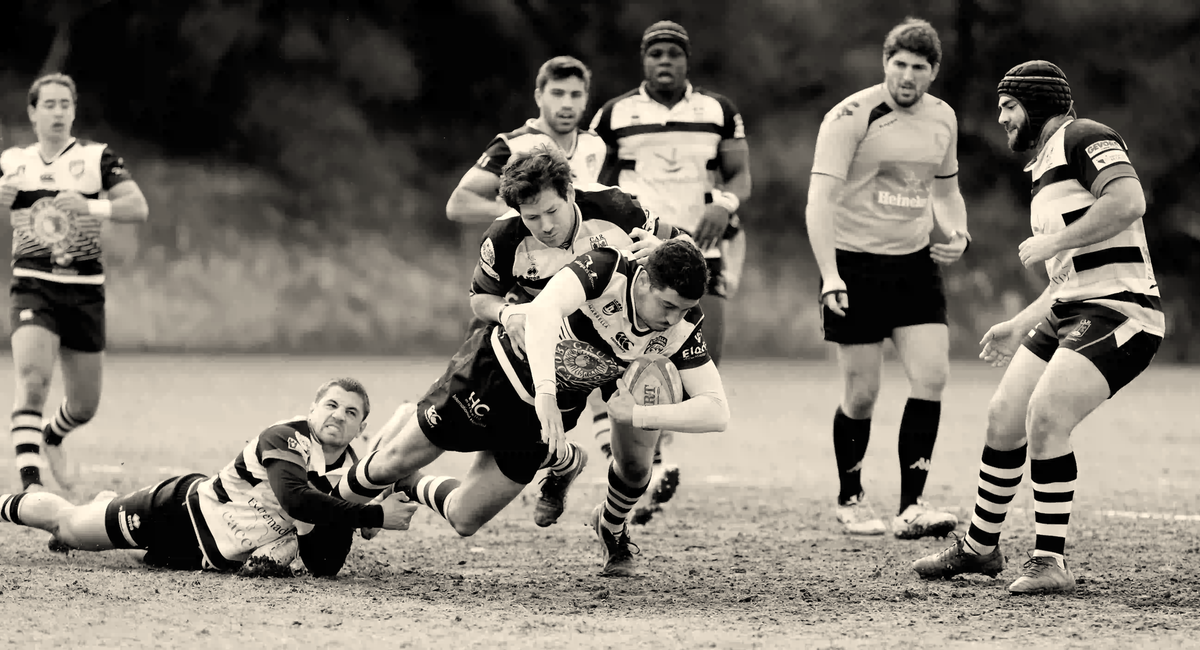
The moment of impact. Hooker grounds the ball; the winger lands on his back. Watch the position of the left shoulder ("ABER")
Why the Shoulder Is So Vulnerable at This Exact Moment
The shoulder is an inherently unstable joint. It has a large ball of a head relative to a shallow plate of a socket: a design that sacrifices stability for mobility. To prevent the ball falling off the plate, a fibrous capsule surrounds the joint, a cartilage lip called the labrum lines the socket rim, and the rotator cuff muscles provide dynamic support from all sides.
In both rugby union and league, scoring a try requires grounding the ball with firm contact between the player and the floor. This can be achieved by simply falling onto your front. However, to avoid embarrassingly winding yourself by landing on the ball, players will usually hold their arms away from the body, either in a Superman pose or out to the side in an abducted and externally rotated position (ABER). In this second position, the joint is at its most vulnerable to injury from a blow from behind.
If the player cradles the ball under their arm, the situation is arguably worse. The ball becomes a rigid fulcrum, so that when an 82 kg body lands onto the back of that shoulder with the momentum of a sprint, the force through a hyper-extended joint is enough to dislocate the shoulder, tear the labrum, or damage the rotator cuff. Dislocation is the most visible outcome: the ball leaving the socket entirely, but the more consequential injury is often the labrum underneath, because it is labral damage that drives the 36% risk of it happening again, and the arthritis that can follow years later.
This is also a recognised mechanism of injury to the latissimus dorsi, the "lats" muscles. The ones that give you those V-taper wings on your back. This is a rare injury, and yet during my time working as a doctor in professional rugby, I saw two of these injuries from exactly this mechanism.
Notably, Hooker had the ball cradled on the non-injured side, which tells us that contact alone was sufficient.
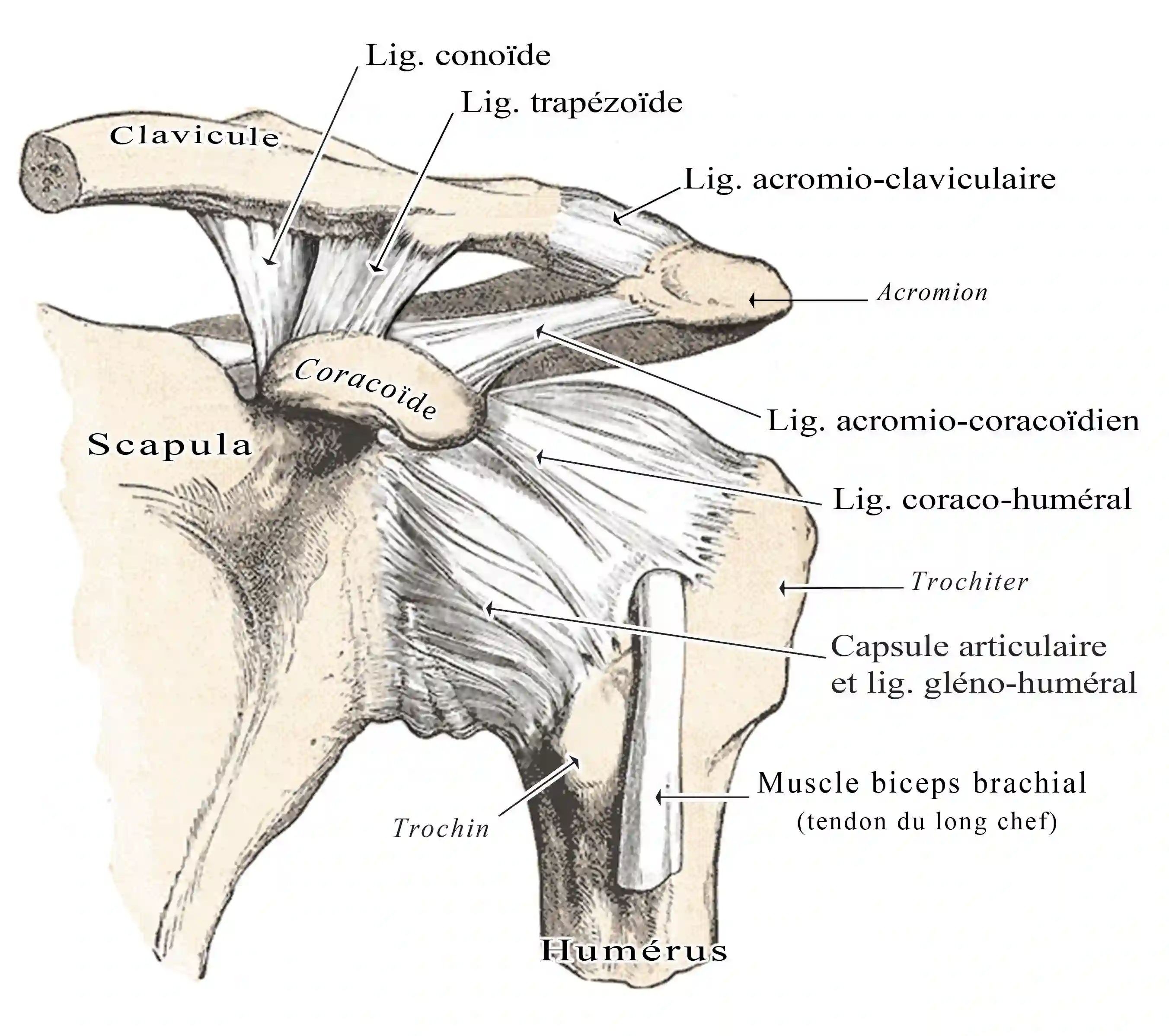
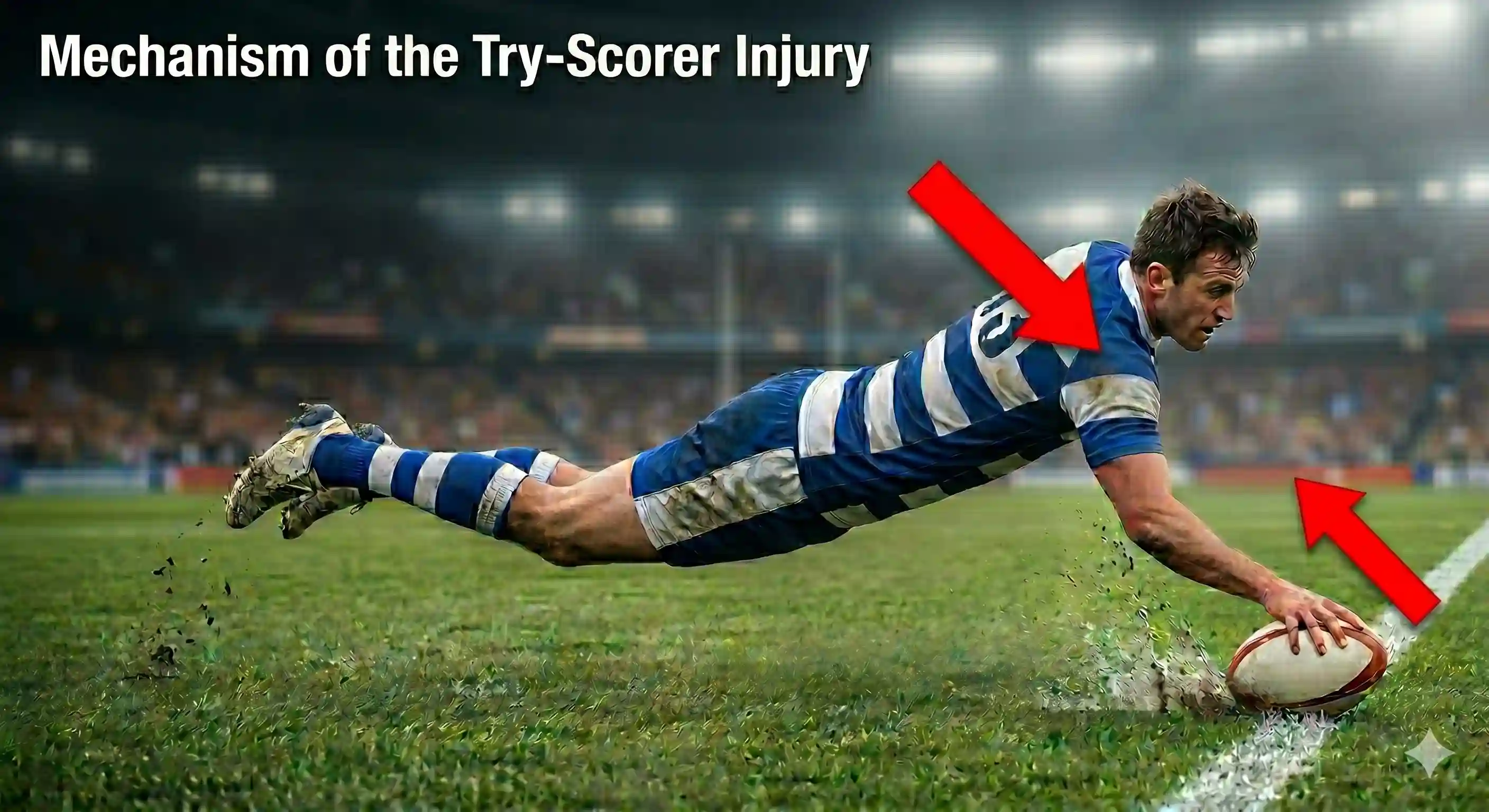
Anatomy of the shoulder joint capsule. Forces acting on the shoulder when scoring a try. The higher arrow represents the body weight of another player.
If It Has a Name, It Happens Enough to Matter
The fact that there is a name for this mechanism of injury, the Try-Scorer mechanism, should tell you that this happens frequently enough to warrant cataloguing. And the regulators are aware, because both codes of rugby have laws to prevent it.
- In Rugby Union, World Rugby Law 9.6 states that a player must not obstruct or in any way interfere with an opponent while the ball is dead. Law 9.13 prohibits tackling an opponent early, late or dangerously. The moment the ball is grounded in the in-goal area, play is dead. Any contact after that point is outside the laws of the game.
- In Rugby League, Section 15 on misconduct states that foul play in the act of scoring carries the most punitive sanction in the sport: the 8-point try, against a normal try of 4 points.
The framework for protection exists precisely because lawmakers understood the vulnerability of the try-scorer. Which is why last weekend's events grated so much. No sanction was administered on or off the pitch, despite the offence and the subsequent injury.
What Am I Actually Asking For?
I am not asking for rugby to be "softened". You cannot remove collision from a collision sport, and nobody should try. Neither am I asking for the sanctioning of a player after the fact.
What I am asking is that this specific behaviour be treated with the seriousness its clinical consequence demands going forward.
To players at all levels: you are competitors, comrades in a brutal yet brilliant sport. Be aware that the moment you land on someone's back, you are risking ending their season and getting yourself carded if not worse. It is not worth it.
To coaches and rugby educators: if players do not fully appreciate that this split-second action can cause an avoidable injury, that understanding needs to be built into the coaching culture at every level. This piece is a start.
To officials and regulators: Ref it out! The laws are written. Consistent, unambiguous enforcement is the only mechanism capable of interrupting the competitive instinct in the moment. If the fear of sanction does not function as a deterrent, it is because the sanction is not being applied.
Frequently Asked Questions
What injury did Ethan Hooker sustain?
Ethan Hooker sustained a shoulder dislocation during the United Rugby Championship match between the Ospreys and the Sharks. The injury occurred after a defender landed on his back following the try being grounded, a mechanism known in sports medicine as the Try-Scorer mechanism.
Can you tackle a player after they score a try in rugby?
No. In rugby union, World Rugby Law 9.6 prohibits interfering with an opponent once the ball is dead, and Law 9.13 prohibits late or dangerous tackles. The moment the ball is grounded in the in-goal area, play is dead. In rugby league, foul play in the act of scoring carries the most severe sanction in the sport: the 8-point try.
What is the Try-Scorer mechanism?
The Try-Scorer mechanism describes the specific biomechanical sequence that occurs when a defender lands on a player who has just grounded the ball. At the moment of scoring, the try-scorer's arm is typically in an abducted and externally rotated position, placing the shoulder at maximum vulnerability. A posterior force applied to the joint at this moment can dislocate the shoulder, tear the labrum, or damage the rotator cuff.
How serious is a shoulder dislocation from rugby?
A first-time shoulder dislocation typically requires several weeks to months of recovery. More significantly, the underlying labral damage that often accompanies dislocation carries a 36% risk of the shoulder dislocating again, and repeated instability can lead to early shoulder arthritis. The clinical consequences are therefore not limited to the immediate injury.
What is the labrum and why does it matter in shoulder dislocations?
The labrum is a ring of cartilage that lines the rim of the shoulder socket, deepening it and providing stability for the joint. When the shoulder dislocates, the labrum is frequently torn in the process. It is this labral damage, rather than the dislocation itself, that drives the long-term risk of recurrent instability and eventual arthritis.
References
World Rugby. Laws of the Game: Rugby Union. Law 9.6 and Law 9.13. worldrugby.org
International Rugby League. Laws of the Game: Rugby League. Section 15: Misconduct.