The Two-Day London Marathon: What a Double Format Means for Medical Care and Public Safety
The 2026 London Marathon set a world record. Ballot entries for 2027 have already hit 1.3 million. A two-day format is on the table. The financial case is straightforward. The medical questions are more interesting.

When the London Marathon launched in 1981, running 26.2 miles was considered an extreme undertaking. Something only elite athletes or committed eccentrics would think of as a good idea. That first race drew around 7,000 runners. The idea that one day 1.13 million people would ballot for roughly 60,000 places would have seemed fanciful, and yet here we are.
With 59, 830 people crossing the finish line, the 2026 London Marathon set a World Record for the largest marathon run ever. But there is demand for more places. Ballot entries for 2027 have already reached 1.3 million.
Considering the London Marathon is the greatest single-day fundraising event on the planet, a record it has broken in consecutive years - the 2025 charitable total exceeded £87.3 million; 2026 is on course to exceed £90 million - it makes sense to expand the capacity to match the ever-increasing demand for places.
The solution proposed to achieve this…? A two-day format: 100,000 runners spread across a Saturday and Sunday, with the field split into two groups of 50,000. Projections suggest that the charitable income from this could exceed £130 million, and the economic contribution to London across the weekend sits at around £400 million, compared to £226 million for the single-day event. The financial case for a two-day event is straightforward. With so many people now seeing running a marathon as an achievable goal, not increasing the capacity is as good as leaving money on the table.
My interest, as ever, is the medical side of things.
Who delivers care on race day
An event of this scale depends on an enormous clinical workforce, the vast majority of whom are volunteers. London Marathon Events' published figures put that at over 1,200 first aiders, more than 250 paramedics from the London Ambulance Service, around 40 to 50 cycle responders, and over 100 specialist doctors distributed along the route. The medical tent at the finish line functions as a field hospital, managing presentations from blisters and muscle cramps through to heat stroke, hyponatraemia (low sodium in the blood from drinking too much water without restoring lost electrolytes), and cardiac events.
Splitting the field across two days reduces the daily participant count from 60,000 to 50,000. The improved staff-to-runner ratio becomes a real clinical advantage because the medics have more time, more resources, and more capacity for careful decision-making per runner.
Individual volunteer shifts are typically 5 to 8 hours, which is well within safe working limits for a single day. The logistical question is whether the same volunteer pool can staff two consecutive days.
Most London Marathon volunteers are drawn from the Greater London area, and many are likely to be available for one day of a given weekend rather than both. A two-day format would require either rostering separate cohorts for Saturday and Sunday, recruiting additional volunteers from outside the capital, or some combination of the two. The organisers may also have to arrange accommodation for those travelling from further afield. A scarce commodity over marathon weekend.
All this creates the possibility of volunteer fatigue as individuals start to find the experience burdensome.
None of this is insurmountable. These are planning and recruitment problems that sit well within the organisers' experience.
The residents along the route
When most people discuss the marathon, the attention is almost entirely on the runners, and little regard is given to the people who live along the route. Depending on who you speak to, residents typically express mixed sentiments about the marathon. For some, it’s a welcome change:
“I now look forward to closed roads and a break from all day loud exhausts. Replacing that with clapping, cheering and some music for a few hours is very nice.”
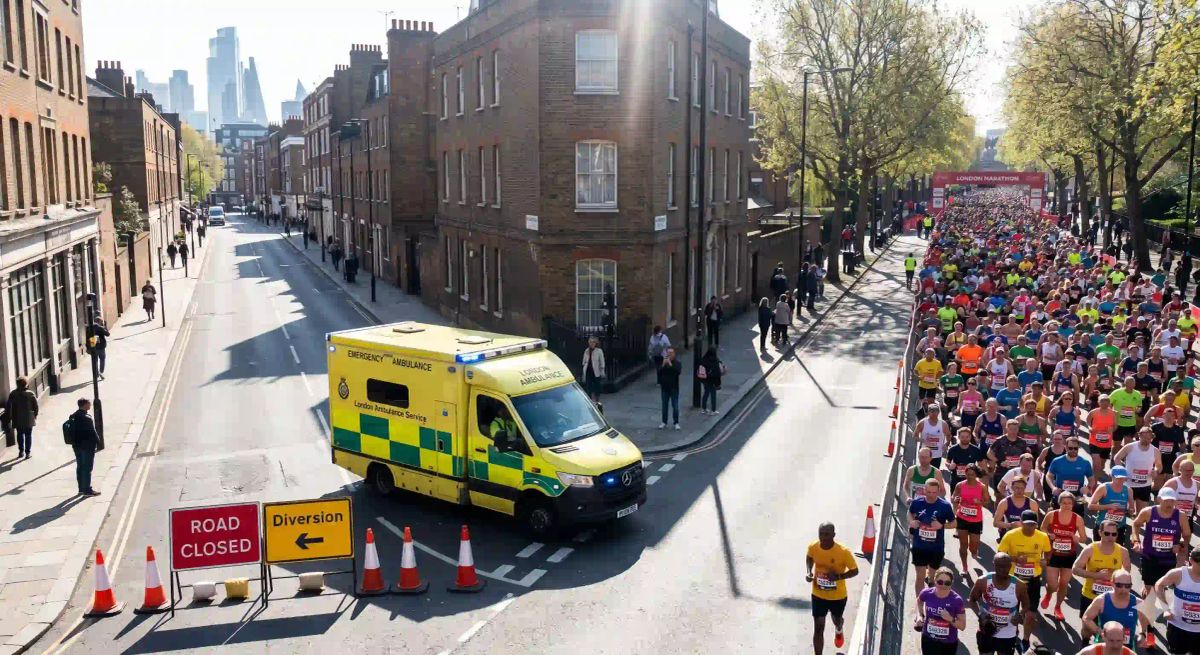
For others, it is a significant disruption to life, with people frequently describing the feeling of being trapped in their own homes due to the sheer volume of runners, road barriers and public transport disruption.
Beyond inconvenience, there is a clinical dimension to that disruption that rarely gets talked about:
A study looking at 11 major US marathons found that ambulance transport times for patients having a heart attack living along a marathon route were, on average, 4.4 minutes longer on race day. Some of the delay was the result of road closures, but a significant portion came from patients who chose to drive themselves to the hospital, assuming emergency services would be too stretched to respond quickly.
That assumption matters clinically. There is evidence that people make decisions about accessing emergency care based on their perception of access rather than the reality. A proportion of those living along a marathon route delay calling for an ambulance, or present to an emergency department under their own steam the following day, not because help was unavailable, but because they believed it was.
Survival from out-of-hospital cardiac arrest falls 7 to 10% for every minute without treatment. At 10 minutes, it becomes very unlikely. An ambulance response time already measured in minutes, extended by a further 4.4, moves a patient along that curve in the wrong direction. For those who drove themselves, the delay was compounded by not getting chest compressions, oxygen, and defibrillation that happen during an ambulance transfer.
A two-day marathon event extends this dynamic across both Saturday and Sunday.
Getting the balance right
On race day 2026, Sabastian Sawe became the first man to run a competitive marathon in under two hours. Tigst Assefa broke her own women-only world record. Another 59,828 people, most of them neither elite nor eccentric, finished the same course, many having raised thousands of pounds for causes that meant something to them personally. The volunteers who lined the route, staffed the aid stations, ran the medical tents, and handed out medals gave up their weekends to make it possible.
That combination of elite performance and mass participation, clinical precision and community spirit, record-breaking fundraising and individual determination, is what makes the London Marathon genuinely like no other event in the world.
Getting the two-day format right is worth the effort. The event has earned that ambition.